
Robert Wilson’s Travels Transcribed

By Kasia Middleton
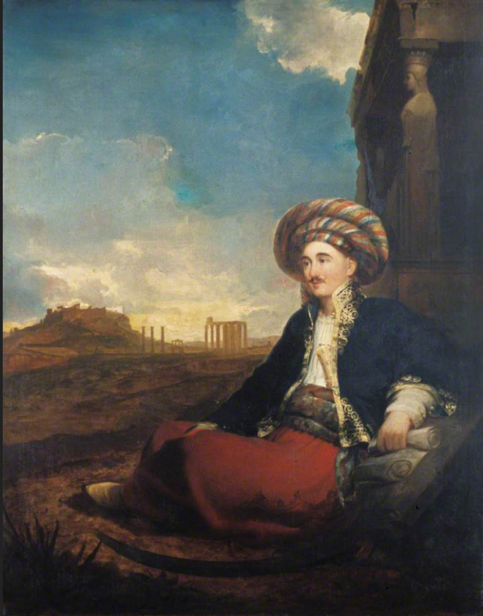
Over the summer, I had the pleasure of working on a transcription internship (via StARIS) for Dr Alexia Petsalis-Diomidis, who is researching the life and travels of Robert Wilson [Fig. 1] (1787-1871), a Scottish physician and traveller at the time of the Grand Tour. He was born in the fishing village of Banff, and was by no means a member of the landed gentry one tends to picture roaming about ruins in the nineteenth century. He studied medicine, and despite having failed his exams, became a surgeon aboard a 502-ton East Indiaman aged eighteen. With the East India Company, and through the imperial links it forged, Wilson made several voyages to India, and eventually moved on from medical work to become the ship’s purser, making his money through these trips, trading goods such as indigo and silk. The interesting thing about Wilson for a scholar of the Grand Tour is that his “humble” background (his mother’s family owned a gardening business and his father was a master builder) affords him a slightly different perspective on things than that taken by someone brought up surrounded by standardised theories and literature on the ancient world. He is slightly freer to express his own thoughts about art and architecture, which often results in interesting comparisons and observations which, for the sake of academic care, may not have been made before. His diaries are evidence enough of his fiercely independent spirit: “I should traverse the country in any way I pleased, remain in places, as long as it suited me, and excavate at any ruin I might deem necessary, the expense of the latter to fall entirely on me, and the produce to be exclusively mine.”
I applied to work on this internship because I had recently completed both a module on the Near East and work experience transcribing inventories for a local historic property. It felt like the perfect opportunity to employ and improve these skills. Much of my experience working on Wilson’s diaries was as I expected it to be, but some things did surprise me. For example, I had erroneously assumed that any misspellings were Wilson’s own, but actually, some quick online searches revealed that many were merely anachronisms. It was interesting to see some form of standardisation across records. It was also interesting to get to know the individualisms of Wilson, and I found that the more I read of his account, the easier it was to decipher his writing, as I developed the ability to intuit what his next move would likely be, or what he was probably going to remark about a situation. It was also helpful to read Dr Petsalis-Diomidis’ work on Wilson’s travels in Greece to understand his past and what may have influenced his perspectives on his Eastern travels. As I move forwards into the final year of my undergraduate career, and consider my future professional prospects, I think that this project will have been a boon to me – I have gained the ability to work to both a schedule and requirements, but more specifically, I now have additional experience in the heritage sector, which is where I see myself ending up.
The sections of Wilson’s travelogues that I transcribed (stored at Aberdeen University library) detail his journeys in 1820-1822 across parts of the Near East which he refers to as Palestine, Syria, Mesopotamia, Assyria, and Babylonia. At the time these territories were part of the Ottoman Empire. Though our modern maps and spellings might differ, the landmarks do not. One of the challenges of transcribing these diaries was to retrace Wilson’s steps despite the inconsistent spellings which plague Grand Tour accounts of this region of the world. It was helpful to find the records of a fellow nineteenth-century traveller, James Silk Buckingham, who took the same route as Wilson but in reverse order. These were recorded in a published book, and thus did not present the same challenges as the manuscript. For example, Wilson’s illegible refreshment stop for his horses in “Sumiman/Sunieman, a considerable Town with a Bridge of Six arches”, was likely Silk Buckingham’s “Sunnymein”, where he reports a seven arched bridge. Thus, although I did not know how Wilson would spell the placename, I was able to pinpoint it on a map. Though when I started transcribing I did not think that it was particularly important to identify the modern geographical names, what I actually found was that if I paid attention to the route on a modern map, it was much easier to look up archaic place names and achieve the best quality transcription. Indeed, prior to finding Silk Buckingham’s route, a particularly challenging list of place names required manually scouring Google Maps for small villages with similar names, to trace Wilson’s route, eventually yielding the rather gruelling-looking hike below [Fig. 2]. This was a long process, as I often had to zoom in dramatically to find smaller locations Wilson visited, which resulted several times in losing track of the route.

There was great reward to be found in decoding Wilson’s phrasing and handwriting – through this internship I have become quite adept at reading even the most hastily scribbled of notes, and have learned much concerning typical routes and attitudes taken by Grand Tourists in the Near East, whereas before I was only really familiar with common practices in Greece and Italy. It cannot be denied that although Wilson’s middle-class background gave him a unique perspective less constrained by academic reading, often comparing Greek and Roman sites to those he encountered in the East, his lofty prose can often dissolve into picturesque, Orientalist rambles concerning things such as “ever verdant meadows”, in cities he was passing. Clearly, influenced by cultural trends of the time, he took quite the Romantic approach to his travels. We also catch glimpses of the practical (if not entirely qualified!) medical man. Writing in Aleppo, he bemoans the luxuries of the East, a common theme in Orientalist writing and painting: “The women here, indulge to an excess in this enervating luxury, and many of their complaints, I attributed, to the weakness occasioned by the warm bath.” Wilson, however, was not one to complain overly, indeed seeming at points to enjoy the rough and ready situations into which he put himself. While contemplating inviting an English traveller to join his party, he states: “my ideas of travelling were so eccentric that they could rarely quadrate with the feelings of any person, having an opinion of his own”. His schemes often attempted to go to places men had not come back from alive. For example, he had wanted to travel down the Euphrates on a raft, and deciphering the brilliant remark of the local governor from whom he needed to get permission was a highlight of my internship:
“by your firman, my head is answerable for the security of yours, and I have a great regard for that part of my body: but, if you are tired wearing yours, take some other means of freeing yourself from the burden, apart from that of descending the Euphrates.”
Of course, the main point of interest in terms of Classical reception is Wilson’s extensive recording of archaeological sites in the Near East, and his collecting of items on his travels. He writes occasionally about his shopping sprees:
“The Bazar [sic.] had not an article of luxury in it; although I was fortunate enough, to pick up there a beautiful antique bronze, or rather copper bust of a man, with a sort of Phrygian cap on his head. This, they informed me, was found near a large stone close to the river, and the length of a man underground. I also got two Roman coins from the silversmith, both Hadrians, and he said there were many stones, with inscriptions upon them, and human figures, to be seen a half days journey down the opposite bank, which behoved to be about the ruins of Hierapolis…”
Of course, we are nowadays aghast by this casual culture of collecting which was embodied by the Grand Tour, but it was quite normal in Wilson’s day. As was the ability to excavate ancient sites and measure coordinates and architectural features virtually unrestricted, especially in remote areas such as the one Wilson voyaged through. He records longitude and latitude diligently. Outside Orfah, he took the time to reproduce Greek inscriptions in his work. In Haran, we see one of his delightfully unencumbered comparisons made in his examination of a local building “not unlike the the remains of the treasury of Atreus at Mycene [sic.]”. Evidently, it is an account rich in intrigue for the student of Classical reception.
Transcribing these diaries was a fascinating and enjoyable experience. We forget, or at least I do, as a student of Classics, that the nineteenth century is not, in fact, especially recent history. I was not just lucky enough to read Wilson’s diaries, but I was also afforded the privilege of being the one to transcribe many pages of them. To touch history in this way, to keep someone alive through their words and experiences, will never cease to thrill me. I only hope I can continue my work at some point, and that it will allow others to get to know Wilson. Although, perhaps even more interestingly, the diaries allow insights into the multitudes of voiceless, nameless people he encounters on his travels, many of whom will have been entirely unaware of the fact their life and existence had been in any way recorded. In that vein, I end with this: Wilson, for all his middling status, writes in that bombastic tone of a Grand Tourist, the one which is deeply passionate about history and humanity, but which also manages to be fairly self-centred. His path was carved by empire, his way forwards forged by connections, money, status, and Western supremacy. As with any Grand Tourist, his insights are invaluable, but should be preserved alongside the memory of how he acquired them. Work on these diaries ensures his legacy. Let it also ensure that of the woman at Aleppo, so destitute she prayed for a shell to land in her property that she might sell it for a few piastres on the off chance it did not detonate. We should remember the small boy who drowned in the Queiq river as his helpless mother watched on. Alongside the descriptions of archaeological sites, the image of a brutal execution at Damascus and a poor man shot dead in Orfah as he carried a skin of milk home should stay with us. I hope the diaries immortalise the petty jealousies and small joys of local women squabbling over the gift of an English handkerchief, the tongue-in-cheek remarks of a local governor faced with Wilson’s stubbornness, and the simple generosity which our traveller encounters over and over again. As historians, we might wish Wilson to have been a more methodical and diligent diarist, but as people, I think we may content ourselves with the unexpected connections his account allows us to form. He may have been an imperialist Grand Tourist, but he was also a man who stopped to include these vignettes. In the words of the man himself: “One forms a particular attachment to every thing [sic.] we are connected with, in travelling.”
Dr Alexia Petsalis-Diomidis is using the journal transcribed by Kasia in her research and will be giving a talk at the Scottish Hellenic Society of Edinburgh on 7 October 2025 on ‘From Banff to Basra: Robert Wilson in the footsteps of Alexander the Great in the 1820’s’.
Bibliography
Petsalis-Diomidis, Alexia. Through “the Eye of an Experienced Traveller” Robert Wilson (1787–1871) in Ottoman and Revolutionary Greece. Edinburgh University Press, 2024.
Silk Buckingham, James. Travels Among the Arab Tribes Inhabiting the Countries East of Syria and Palestine. Longman, Hurst, Rees, Orme, Brown and Green, 1825.